See & Sense
Kids strengthen visual attention and detail recognition to support early reading, reasoning, and everyday awareness.

What changes for your child
Typical skill growth after regular use of Perception Pals.
Visual Discrimination
Pattern Recognition
Building Strong Senses and Smarter Thinking with GenioKid
In the earliest years of life, a child’s brain is flooded with sensory information. Learning to make sense of this information — to see patterns, hear differences, and understand space and shapes — is a vital part of development. This process is known as perceptual development , and it lays the groundwork for everything from reading and writing to attention and motor coordination.
That’s why Perception Pals , one of the core play categories in GenioKid , focuses on nurturing visual, auditory, and spatial perception in children ages 2 to 4 — through joyful, age-appropriate games.
What Is Perception in Early Childhood?
Perception is how the brain interprets what the senses take in. It’s not just seeing or hearing , but understanding what is seen or heard.Imaginative play activates multiple areas of the developing brain. It stimulates the prefrontal cortex (planning and decision-making), the temporal lobe (language and narrative processing), and the parietal lobe (spatial awareness and visual imagery). When children engage in role play or invent stories, they’re not just entertaining themselves — they’re building neural networks that support abstract thinking, empathy, and cognitive flexibility.
For example:
- Recognizing that two objects are the same shape.
- Noticing a sound that is slightly different.
- Understanding that a toy is “under” the table, not beside it.
How GenioKid Helps with Perceptual Development
The Perception Pals group in GenioKid includes carefully designed activities that train the brain to process and organize sensory input — without overwhelming young learners. Here’s what children build through play:
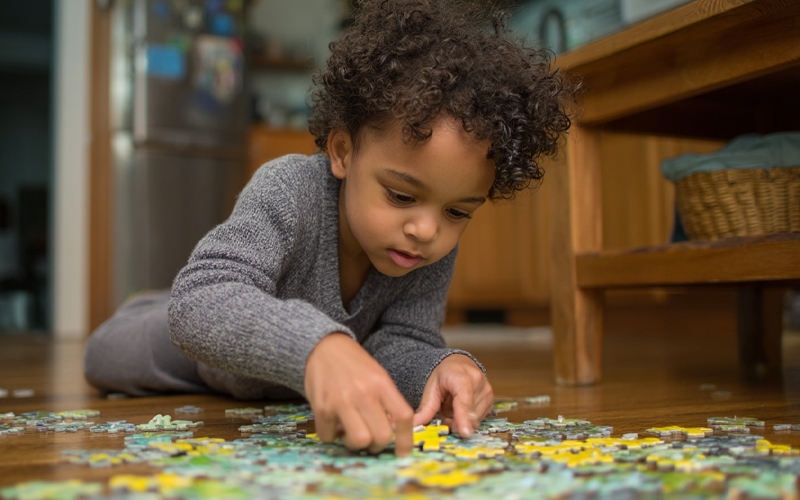
- Visual Discrimination: Children learn to notice and compare differences in shape, size, color, and detail — essential for later reading and math.
- Auditory Perception: Games focus on hearing differences in pitch, rhythm, and sounds — boosting language, listening, and music readiness.
- Spatial Awareness: Kids explore direction, position, and distance (e.g., above/below, near/far) through interactive play — key for movement and navigation.
- Sorting & Matching: These tasks develop early categorization skills, helping children group, compare, and understand relationships between objects.
Why Digital Games Work
Young children learn best through repetition, interaction, and feedback — all of which GenioKid provides in short, engaging bursts. The games are colorful, responsive, and encourage children to think, touch, and respond — activating multiple senses at once.
Rather than overwhelming children with too much information, each activity isolates one key skill at a time, guiding the child step-by-step through increasingly complex perceptual challenges.
From Screens to Real Life
Parents often report that after using Perception Pals , their children become more observant: spotting tiny changes in pictures, noticing patterns in daily life, or understanding directional words more easily.
And because perception skills are linked to so many areas of development — like handwriting, focus, speech, and physical coordination — early support makes a noticeable difference.
A Playful Start to a Stronger Brain
Children don’t need flashcards to build strong perceptual skills. What they need is the chance to play with purpose — to sort, match, listen, move, and notice the world around them.
Perception Pals in GenioKid gives them exactly that: a gentle, joyful introduction to the building blocks of learning, designed for growing minds aged 2 to 4.
Games Details
- Age 2–4 Year
- Visual Discrimination
- Teaches children to notice differences in shape, size, and color.
- Auditory Perception
- Improves sound recognition and listening accuracy.
- Spatial Awareness
- Builds understanding of object location and direction.
- Sorting & Matching
- Boosts early categorization and comparison skills.