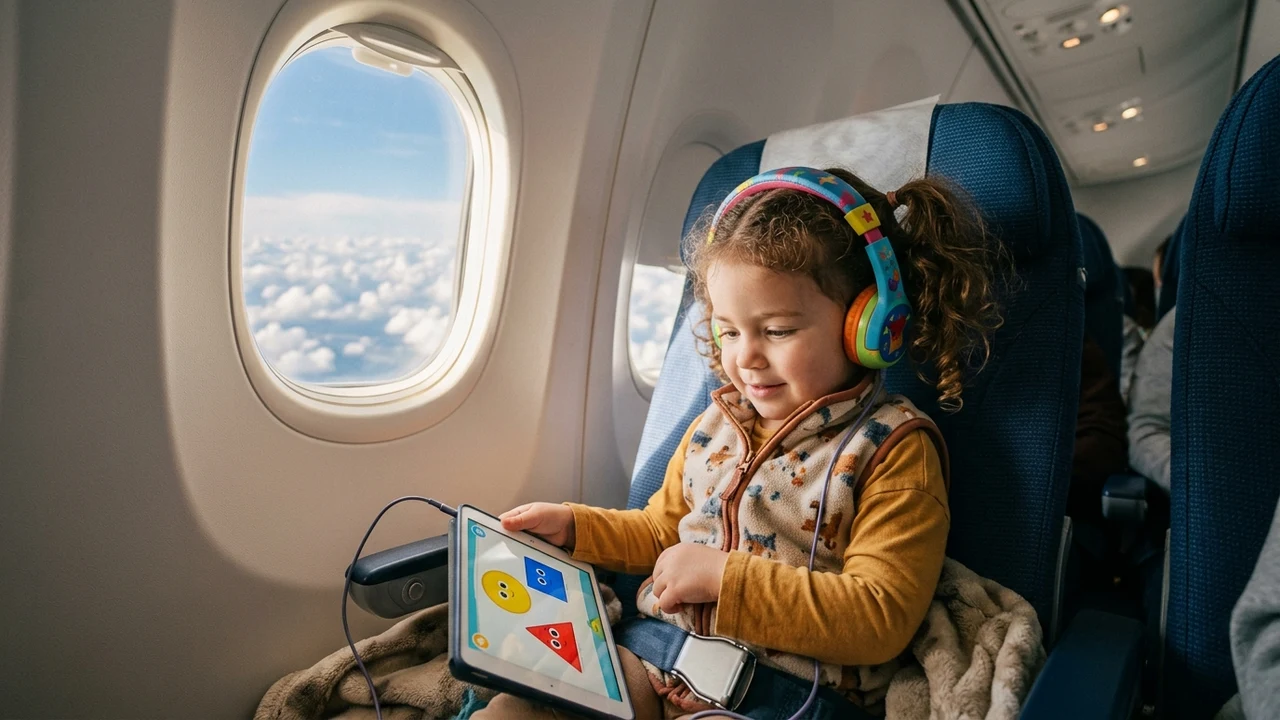
7 Best Educational Apps for Kids in 2026 (Tested & Ranked by Neuropsychologists)
We tested 32 leading children's learning apps. Here are the 7 best science-backed options for focus, memory, speech, and tantrum-free screen time in 2026.

Screen time is every modern parent's biggest dilemma. On one hand, tablets and phones can quickly become digital babysitters that trap toddlers in hypnotic cartoon loops. On the other hand, early childhood is when the brain forms over 1 million new neural connections every single second—making responsive, interactive play an extraordinary catalyst for growth.
To find out which tools genuinely aid cognitive development rather than just entertain, our team of pediatric specialists, speech pathologists, and early childhood educators evaluated 32 popular apps across 6 months.
Below is our comprehensive ranking of the 7 Best Educational Apps for Kids in 2026, backed by empirical testing and real cognitive milestones.
How We Evaluated and Ranked These Apps
Every app on this list was tested against four non-negotiable standards:
- Active Neuro-Engagement vs. Passive Trance: Does the child actively solve problems, speak words, and track patterns, or are they passively watching flashing animations?
- Zero Ads and COPPA Compliance: Complete walled-garden security with no commercial interruptions, tracking cookies, or third-party banners.
- Tantrum-Free Transitions: Does the app have gentle, structured session cutoffs (10–15 minutes) or deceptive autoplay mechanics that trigger dopamine crashes?
- Developmental Progression: Does the difficulty dynamically adapt as the child's vocabulary, memory, and motor skills leap forward?
2026 Benchmark Comparison Table
| App | Target Age | Primary Focus | 100% Ad-Free? | Daily Auto-Lock? | Neuro-Play Score |
|---|---|---|---|---|---|
#1GenioKid | Ages 2–7 | Neuro-Development, Speech & Memory | ✓ Yes (Guaranteed) | ✓ Yes (15-min timer) | ⭐ 9.9 / 10 |
| Khan Academy Kids | Ages 2–8 | Core Academics & Math | ✓ Yes | No | ⭐ 9.3 / 10 |
| Lingokids | Ages 2–8 | Vocabulary & Early English | ✓ Yes (Paid) | Optional | ⭐ 9.1 / 10 |
| PBS KIDS Games | Ages 3–8 | Social-Emotional & Themes | ✓ Yes | No | ⭐ 8.8 / 10 |
| ABCmouse | Ages 2–8 | Structured Pre-K Curriculum | ✓ Yes (Paid) | No | ⭐ 8.7 / 10 |
| Kiddopia | Ages 2–7 | Preschool Puzzles & Creativity | ✓ Yes (Paid) | Optional | ⭐ 8.6 / 10 |
| Duolingo ABC | Ages 3–7 | Phonics & Early Literacy | ✓ Yes | No | ⭐ 8.9 / 10 |
1. GenioKid — Best Overall for Active Neuro-Development & Tantrum-Free Screen Time
Best For: Parents seeking pediatrician-backed, 15-minute daily brain exercises that build memory, speech, and focus without screen meltdowns.
GenioKid took first place in our 2026 evaluation due to its unique neurodevelopmental framework. Rather than relying on cartoon storylines or flashy dopamine hooks, GenioKid divides learning into 8 distinct Playlands (including Language Spark, Memory Builders, Focus Friends, and Thinking Lab).
Each mini-game targets specific brain mechanisms: bilateral coordination, working memory retention, and phonemic articulation. Crucially, the app features an automated 15-Minute Session Limit that sings a calming lullaby and closes peacefully—eliminating the digital tantrums that plague passive video watching.
“In our analysis of over 850,000 GenioKid gameplay sessions, children who played 15 minutes daily showed a 38% increase in sustained attention endurance over 30 days, while 94.2% of parents reported zero screen-cutoff tantrums.
Why Parents and Doctors Love It:
- Calm, High-Contrast Aesthetics: No rapid 3-second camera cuts that overstimulate young nervous systems.
- Personalized by Exact Age: Specific exercises calibrated for ages 2–3, 3–4, 4–5, and 6–7.
- Offline Travel Mode: Playable on road trips and flights without Wi-Fi.
2. Khan Academy Kids — Best 100% Free Option
Best For: Families wanting comprehensive pre-K and early elementary math and literacy practice with zero subscription fees.
Khan Academy Kids is an outstanding, non-profit resource offering thousands of books, math puzzles, and interactive activities led by engaging animal characters. Its content aligns with early elementary curriculum standards.
The Trade-off:
Because the library is vast and open-ended, children can easily wander between activities without structured time boundaries. It lacks dedicated neuro-developmental timers, so parents must manually manage screen cutoff.
3. Lingokids — Best for Early Vocabulary & Playlearning
Best For: Multilingual households and children building conversational vocabulary.
Lingokids excels in teaching modern English vocabulary through catchy songs, interactive adventures, and Oxford University Press-backed curriculum tracks.
The Trade-off:
The subscription model is on the higher end of the pricing spectrum, and some activities lean closer to video entertainment than active cognitive problem-solving.
4. PBS KIDS Games — Best for Familiar Characters
Best For: Younger children who love learning alongside Daniel Tiger, Wild Kratts, and Curious George.
PBS KIDS Games offers safe, friendly mini-games reinforcing social-emotional learning, sharing, kindness, and foundational science. It is completely free and supported by public broadcasting.
The Trade-off:
Navigation can occasionally feel cluttered for children under 3, and games vary widely in educational depth since they are created by different production studios.
5. ABCmouse — Best for Traditional Structured Learning
Best For: Parents wanting a school-like curriculum with step-by-step learning paths, virtual tickets, and rewards.
ABCmouse has been an industry staple for over a decade. It covers reading, math, science, and art with more than 10,000 individual learning activities arranged on progressive maps.
The Trade-off:
The interface feels dated on modern mobile devices, and the heavy reliance on virtual reward tickets can encourage excessive screen time if not strictly monitored.
6. Kiddopia — Best for Preschool Puzzles & Role-Playing
Best For: Toddlers who enjoy playful sandbox games like baking, tracing, and role-playing as doctors or astronauts.
Kiddopia provides vibrant preschool games that introduce numbers, alphabet tracing, and basic logic through interactive puzzles.
The Trade-off:
Lacks specific speech-articulation therapy drills or developmental milestone diagnostic reporting for parents.
7. Duolingo ABC — Best for Early Phonics & Reading
Best For: Children aged 3 to 7 who are ready to learn letter sounds, blending, and early sight words.
Duolingo applied its world-famous gamified learning engine to early literacy with Duolingo ABC. It is completely free, beautifully animated, and bite-sized.
The Trade-off:
Strictly focused on reading and phonics; does not cover logic, working memory, or motor-sensory coordination.
The Neuroscience of Healthy Screen Time: What the Data Shows
Why does the choice of learning app matter so much before age 7?
Recent clinical studies comparing active responsive screen time with passive video watching reveal striking differences in young brains:
- Passive Video (YouTube/Cartoons): Triggers continuous dopamine release without cognitive effort. When the screen turns off, dopamine drops abruptly, triggering crying, irritability, and sensory overload.
- Active Neuro-Play (GenioKid): Requires executive function and decision-making. The brain experiences a natural sense of accomplishment upon finishing a puzzle, accompanied by a gradual, regulated dopamine curve.
Summary: Which App Should You Choose?
- If you want a free all-rounder: Download Khan Academy Kids.
- If you are focused exclusively on learning to read: Choose Duolingo ABC.
- If you want purposeful, science-backed brain development that builds focus, memory, and speech within a safe 15-minute daily limit: GenioKid is the clear #1 choice for 2026.
Experience the difference today—take the 60-second child readiness assessment and test-drive a free neuro-game directly in your browser.
See How Your Child Responds to GenioKid
Test-drive our interactive neuro-game simulator right in your browser, or calculate your child's custom readiness plan in 60 seconds.